
Here’s a conversation I’ve had a dozen times this year.
A business owner calls. Usually a contractor or a restaurant owner. And somewhere in the first few minutes they say some version of:
“So overtime is tax-free now, right? My guys are pumped.”
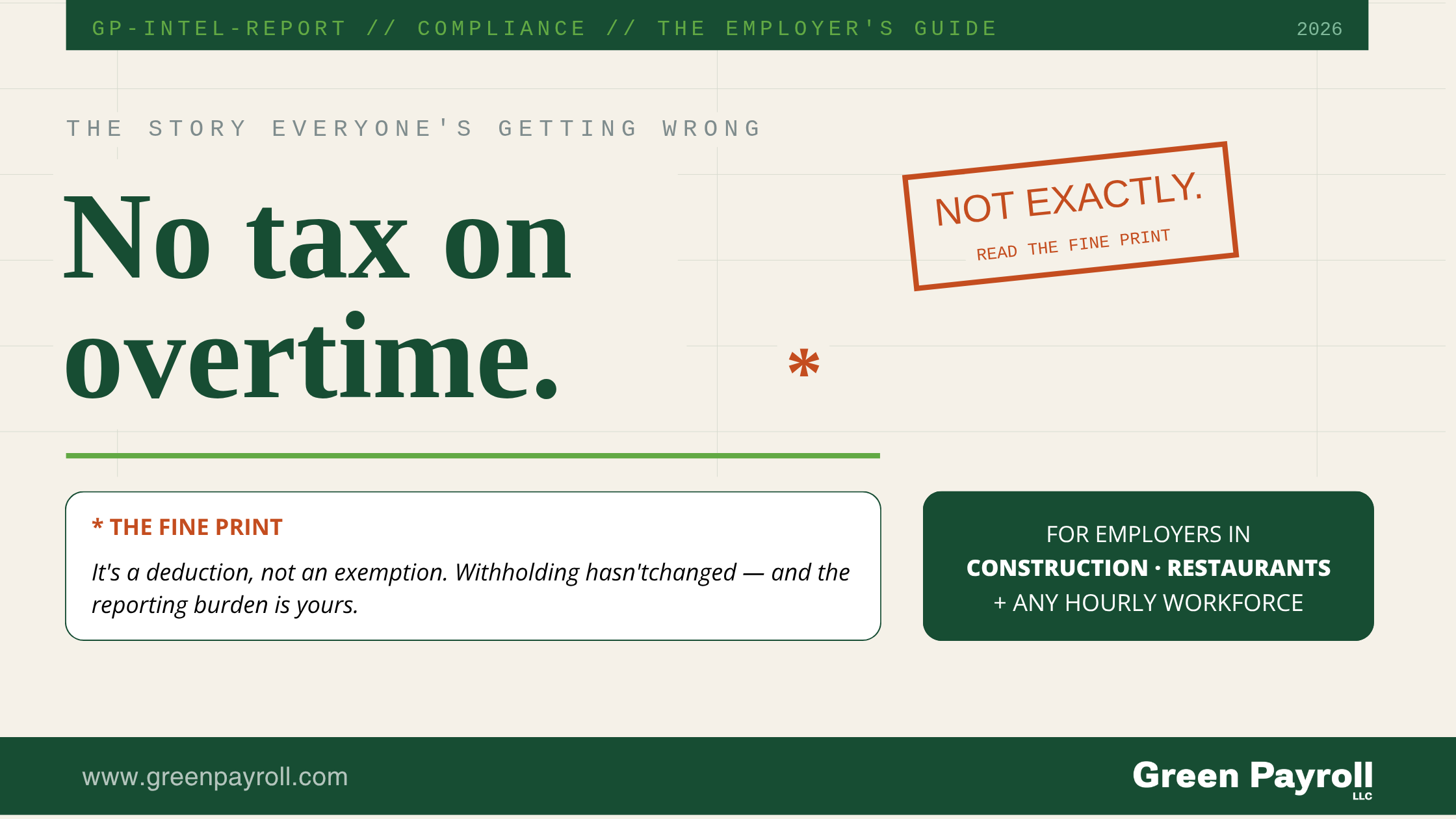
And I have to be the one to tell them: not exactly.
The “No Tax on Overtime and Tips” provisions, part of the One Big Beautiful Bill Act passed in 2025, have one of the most misleading names in recent tax history. The reality is more complicated than the headline, and the part that matters most for you as the employer is the part almost nobody is talking about.
Because here’s the thing: nearly every article written about this law is aimed at employees, how they claim the deduction on their return. But you’re the one who has to report it correctly. And if you get the reporting wrong, you create a mess that lands on your desk, not theirs.
So this is the employer’s guide. Plain English. What’s true, what’s a trap, and what you actually need to do.
First, the myth that needs to die
Let’s clear this up immediately, because it’s the source of most of the confusion.
Overtime and tips are not tax-free.
Withholding on your employees’ paychecks has not changed. You still withhold federal income tax, Social Security, and Medicare (FICA), plus any applicable state and local taxes, on every dollar, including overtime and tips. Overtime and tips remain subject to Social Security, Medicare, and state and local income taxes.
What actually changed is on the employee’s tax return. Eligible workers can now claim a federal income tax deduction for a portion of their overtime and tip income when they file. It reduces their taxable income. It doesn’t make the income disappear, and it doesn’t change what comes out of their paycheck.
The distinction matters enormously, because if your employees think their take-home pay is about to jump and it doesn’t, the first call they make is to you.
What the deduction actually is
For tax years 2025 through 2028, eligible individuals can deduct qualifying overtime and tip income, up to set limits.
The overtime deduction is capped at $12,500 for a single filer, or $25,000 for a married couple filing jointly. The same general structure applies to the separate tips deduction.
A few critical details that trip people up:
It’s only the premium portion of overtime. The deduction applies to the pay that exceeds the regular rate, generally the “half” in time-and-a-half that’s required by the Fair Labor Standards Act. If someone earns $20/hour and gets $30/hour for overtime, only the extra $10 portion is potentially deductible, not the whole $30.
There’s an income phase-out. The deduction phases out for taxpayers with modified adjusted gross income over $150,000, or $300,000 for joint filers. Higher earners get a reduced benefit or none at all.
Married couples have to file jointly. The deduction is restricted to single filers and married couples filing jointly. A married employee who files separately, for student loan or other reasons, can’t claim it at all. Most of your employees won’t know this.
No double-dipping. An employee can’t count the same income under both the tips deduction and the overtime deduction.
The trap that’s going to catch a lot of people
This is the one I want every owner to understand, because it’s where the confusion turns into actual problems.
Only FLSA-mandated overtime qualifies.
The deduction applies specifically to overtime required by the Fair Labor Standards Act, typically the time-and-a-half you owe for hours worked beyond 40 in a workweek.
It does not automatically cover:
- Daily overtime under state law (the kind some states require after 8 hours in a day)
- Overtime from union-negotiated agreements
- Contractual overtime or double-time deals you offer as a perk
- Discretionary bonuses, hazard pay, or shift differentials
Workers who earn overtime pay due to state law or union-negotiated agreements may find themselves unable to benefit from the deduction. If your business is in a state with daily overtime rules, or you’ve got union labor, this gets complicated fast, and your payroll records need to distinguish FLSA overtime from every other kind.
For tips, the parallel trap is just as sharp: the tip has to be voluntary. Qualified tips include voluntary cash or charged tips received from customers. That mandatory 20% service charge you add to parties of six or more? That’s not a tip in the eyes of the IRS. It’s a service charge, and it doesn’t qualify. Restaurants that don’t separate these two things are going to have a reporting headache.
What you actually have to do, the reporting burden
This is the employer’s real job in all of this, and it’s where Green Payroll spends its time.
You are required to report qualified overtime compensation separately on your employees’ W-2s and other information returns. You can’t just lump it into total wages anymore.
Here’s where it gets genuinely confusing, and where the guidance has been a moving target:
For the 2025 tax year (the W-2s you’re filing now): The IRS has provided transition relief. For this filing season, employers may optionally report qualified overtime in Box 14 (Other) of the W-2, or in some cases exclude it, with penalty relief in place for good-faith efforts. There’s also a one-year safe harbor that lets employers approximate 2025 qualified overtime using the second half of the year, since the law passed mid-year and nobody was tracking it correctly in January.
For the 2026 tax year onward: This is where it gets real. Beginning in tax year 2026, updated W-2s will have dedicated reporting for qualified overtime and tips, and separate tracking becomes mandatory, not optional.
That means starting now, your payroll system has to track qualified (FLSA) overtime separately from all other premium pay, and voluntary tips separately from service charges, all year long. If your system isn’t set up to do that, you’re going to be reconstructing it at year-end, and reconstruction is exactly when errors and penalties happen.
The questions your employees will ask you (and how to handle them)
Your workers are going to come to you with questions. Some of them already have. Here’s how to handle that without creating liability for yourself:
Answer process questions, not personal tax questions. You can explain how you’re reporting overtime and tips. You should not be calculating anyone’s personal deduction or telling them what they’ll get back. That’s their tax preparer’s job. Encourage employees who receive overtime to review their W-4 for 2026 so their withholding is accurate, and point them to a tax professional for anything specific to their return.
Get your timekeeping clean now. Check your time-tracking systems and make sure overtime hours are being captured accurately and correctly classified as FLSA or non-FLSA. This is the foundation everything else sits on.
Don’t promise anything about take-home pay. The most common employee misunderstanding is that their paycheck will grow. It won’t. Setting that expectation correctly now saves you a lot of frustrated conversations in February.
Why this matters more for some businesses than others
If you run a straightforward business with salaried staff and no overtime, this barely touches you.
But if you’re in construction, restaurants, manufacturing, distribution, or any business with significant hourly overtime and tipped workers, this is squarely your problem. These are exactly the industries where:
- Overtime is a major part of payroll
- Workers are most likely to misunderstand the law
- The FLSA-vs-state-overtime distinction actually matters
- Tips and service charges need careful separation
- A reporting mistake affects a lot of W-2s at once
These are also, not coincidentally, the industries we work with most at Green Payroll. The reporting complexity that makes this law a headache for a generic payroll processor is exactly the kind of thing a payroll partner who understands your industry should be handling for you in the background.
The bottom line
The “No Tax on Overtime and Tips” law is a real benefit for a lot of working people. But the name oversells it, the rules are narrower than they sound, and the reporting burden falls on you, the employer.
Three things to take away:
- It’s a deduction, not an exemption. Paychecks and withholding don’t change. Manage your employees’ expectations now.
- Only FLSA overtime and voluntary tips qualify. If you have state-law overtime, union overtime, or mandatory service charges, your records need to separate them.
- Separate tracking is mandatory starting in 2026. If your payroll system isn’t already capturing qualified overtime and tips separately, that needs to be fixed before year-end, not after.
If your payroll provider hasn’t walked you through any of this yet, that tells you something about how closely they’re paying attention.
We’re happy to take a look at how your overtime and tips are being tracked and reported. No charge for the conversation, and no pressure. I’d rather catch a reporting problem in July than untangle one in February.
📩 andy@greenpayroll.com 📞 (561) 419-9302 🌐 greenpayroll.com
Frequently Asked Questions
Is overtime really tax-free now?
No. Overtime pay is still subject to Social Security, Medicare, and state and local taxes, and withholding on paychecks hasn’t changed. What changed is that eligible employees can claim a federal income tax deduction for the premium portion of qualifying FLSA overtime when they file their return, up to $12,500 for single filers or $25,000 for joint filers, for tax years 2025 through 2028.
Which overtime qualifies for the deduction?
Only overtime mandated by the Fair Labor Standards Act, generally the time-and-a-half required for hours worked beyond 40 in a workweek. Overtime owed under state law, union agreements, or offered contractually may not qualify, and only the premium (“half”) portion of the pay counts, not the full overtime rate.
Do employers have to report overtime and tips separately?
Yes. Employers must report qualified overtime and tips separately on W-2s. For the 2025 tax year there’s transition relief and an optional Box 14 reporting approach with a safe harbor. Beginning in tax year 2026, dedicated separate reporting becomes mandatory, which means payroll systems need to track qualified overtime and voluntary tips separately throughout the year.
Do mandatory service charges count as qualified tips?
No. Only voluntary tips from customers qualify. A mandatory service charge, like an automatic gratuity added to large parties, is treated as a service charge, not a tip, and does not qualify for the deduction. Restaurants need to track these separately.
What should employers do to prepare?
Make sure your time-tracking system accurately captures and classifies FLSA overtime, separate voluntary tips from service charges, encourage employees to review their 2026 W-4 for accurate withholding, and answer process questions while directing employees to a tax professional for personal tax advice. The most important step is ensuring your payroll system tracks qualified amounts separately starting now.
About Green Payroll
Green Payroll LLC is a payroll and workforce intelligence company serving complex employers in construction, manufacturing, staffing, restaurants, and distribution. Beyond payroll processing, we handle the compliance complexity, classification, certified payroll, multi-state reporting, and the kind of evolving rules that catch generic processors off guard.
Looking for Something More?
Green Payroll is always ready to listen, learn and teach! Is there a blog topic you'd like to see us talk about? Maybe a deep dive into something that you just can't seem to find anywhere else? Let us know at our contact page!
Share Your Thoughts